Showing posts with label art. Show all posts

Wednesday, January 18, 2012

Greying out the blog

Yeah, it's the SOPA and PIPA legislation.  On one hand, piracy--both domestic and international--is preventing writers, musicians, and other artists from making a living wage.

On the other hand, the federal government taking down your web site because someone else illegally uploads stuff to your site even though you have policies against it is not only messing with due process, but it can potentially have a freezing effect on First Amendment rights.

So this post is officially greying out (not blacking out) the blog today.   I have come to hate it when people steal my stuff and make money off me without my permission or sharing the profits with me.  I have come to hate that if I had to live on what I make from my writing, I'd be lucky to be living in a tent under a bridge (and that's after writing for major NYC publishers).  I have come to hate that people are willing to pay $5.00 for the experience of having a barista make a three-minute fancy cup of coffee that normally would cost 50 cents if they did it themselves, but want to experience for free the stories that have taken me almost a year each to write.

And that's saying a lot, because I love my lattes and am willing to shell out $5.00 plus tip for a nice fancy venti latte at Starbucks.  Especially because I know those baristas are often students who are trying to make it through to graduation.  Been there, done that.

But I also do not like that the federal government is incredibly clumsy about securing the rights I have over my property, so clumsy that they write legislation that can damage new and innovative ways of getting my stuff out there so that I and others can make a living wage.

There is a middle way. There is a way for online businesses like YouTube and Google and everyone else to make profits for themselves and still pay the content providers (writers, musicians, artists).

Here's an idea:  Every time someone uploads a copyrighted video to YouTube, if YouTube finds it, they charge the uploading subscriber 50 cents.  Then YouTube turns around and splits that amount with the copyright holder.  Anyone can upload whatever they want.  But they will be charged for uploading something with a copyright that belongs to someone else.

That's fair, isn't it?  50 cents isn't a lot for one person.  It's the price of a latte if you were to make it yourself.   If you think something you like is worth posting on YouTube, you can think about whether it's worth 50 cents to do it.  If it is, then you can rest easy in the idea that all those people who worked hard to make that video--writers, musicians, artists, cinematographers, the guy who sweeps the studio floor--all get paid to feed their families.  But if a video is good enough that millions of people think it's worth 50 cents each to upload it, then that will add up to enough money to help keep writers, musicians, artists, cinematographers, and the guy who sweeps the studio floor in a job.

We're in a bad economy. A heck of a lot of people don't have jobs.  Economists say that one big reason why we don't have jobs and are in such a big economic hole is that we don't create and produce enough products in our own country.  Not enough to export to other countries.

One of the very few things left that we in the United States do produce and export is music, writing, and art.  Ironically, very few of us in the U.S. want to pay for it or support it.  We don't want to buy the very thing that helps our economy get better. We want it for free.

That ebook you see on Amazon, written by an American?  That rightly and proudly should have a stamp on it that says "Made in the U.S.A."  You see that book in your local bookstore or that song written by a local musician on iTunes?  That book's been translated into different languages as an export, and that song's on a CD that's being exported to another country.  Someone not only wrote that book and performed that music, but a lot of other people printed that book and created the cover art, and produced that song and made it into a CD.  All done in the U.S.A.

It brings other countries' money into our country.  It pays our people.  Art, music, and books that Americans create keeps jobs in our country.  It's one of the very few things that still do.

Support free speech, but make sure to pay people for the work they do--and that includes paying people who create and help create art.  It means you, in the end, will have a better chance at keeping your own job as well.

Friday, May 21, 2010

Castle Hoensbroek - 17th and 18th Century portion

Back to the castle....

I felt considerable relief when we entered the later portions of the castle. I should mention that you first enter the modern portion, and then go into the medieval part. You can see that here:

The drawbridge that goes into the castle goes into the modern part first. In this picture, you can see the drawbridge, and to the right is the cylindrical medieval tower.

In the courtyard, there are various items from the daily life of the castle, with the exception of the cannon.

I find it interesting that clothes were hung up on poles instead of on clotheslines, but it makes sense. Clotheslines would involve the mass production of clothespins, and hanging clothes on ropes instead of putting the poles through the clothes' armholes would risk the chance of the clothes flying off in the wind. Although I suppose one could thread the rope through the clothes' armholes.  Still, it wouldn't be as stable as poles.

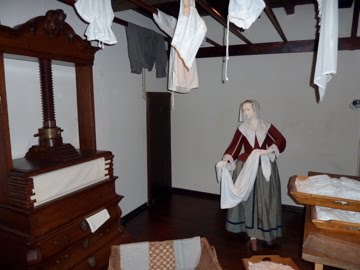
You see the same thing indoors:

The servant girl you see in this picture is dressed in clothes from the 1660's. I assume the piece of furniture on the left is a clothes press, perhaps something to press the wet from the clothes or sheets. Yet...wouldn't that mess up the wood? Make it warp? It seemed to be a fine piece of furniture, so perhaps it was used when the clothes or sheets were dry. Hmm. It would be interesting to see how it actually works.  It looks similar to a printing press, doesn't it?  From what I understand, the basic design for the printing press came from clothes presses.


From the looks of the cannon, I doubt it dates from any earlier than the mid-1700's. I could be wrong but the barrel's too sophisticated for medieval engineering. I admit I don't know much about artillery, but my gut feeling is that this is certainly not medieval, it is muzzle-loading, and was moved via an attachment to a horse's harness. My feeling is that it's from the 1700's at the earliest. My brother Allen would probably know for sure.

Here's the lovely staircase to the upper floors of the castle:

I love the carpet on the stairs. The Hoensbroek family ancestors line the stairwell all the way to the top. The paintings range from approximately the early 1700's to the late 1800's.


Here are pictures of two different bedrooms.  The bed in the first one dates--I believe--from the 17th century:


The clothes in the last one date from the 1700's, I'd say around the 1770s.

Now here's a lovely scene: It's the castle drawing room, with one of the ladies at the harpsichord. The clothes date from approximately 1760 to 1770. The portrait of the lady, however, is from the mid to late 1600's.


This tapestry was in one of the dining rooms:

It seems to represent an exotic Asian countryside. The bird in it, however, is too fantastical for me to identify. :-D I couldn't help notice it, however, having been trained to notice such things by my mother, the expert tailor. Here is a detail of it--beautiful work:


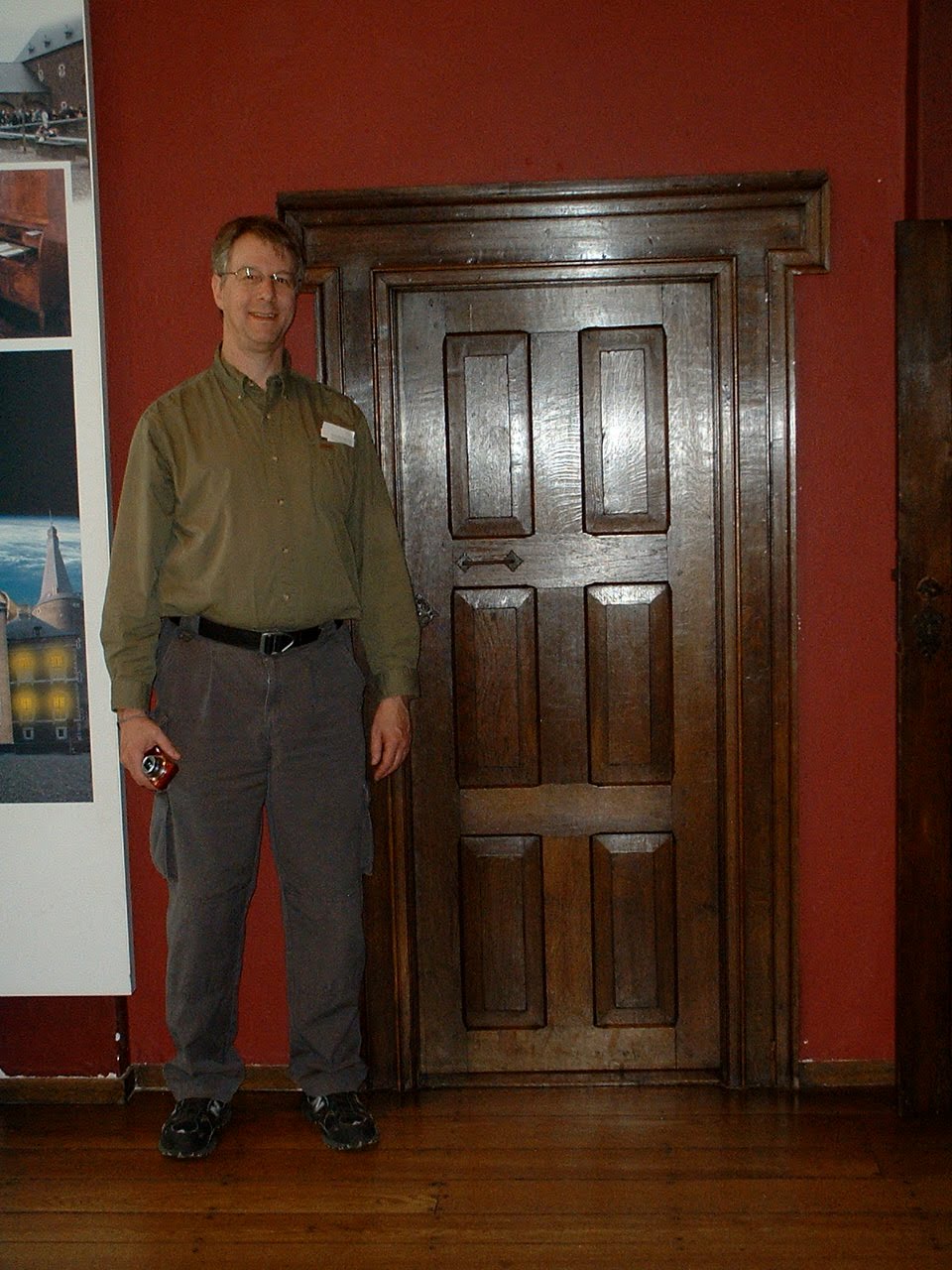
Oh, and the people of these times grew perhaps a little, but they're still not as tall as people these days. Here is John next to one of the doorways.

John is 6 foot 3 inches, as a comparison; he's standing heels against the wall. You'd have to be shorter than 6 feet to go through these doors without ducking.


We then went into a room that was clearly the castle's version of the Man Cave, i.e., the Game Room. The guns are flintlocks--rifles and muskets.

There were various animals taxidermically displayed (birds as well as mammals) in various poses, but I don't think we took pictures of them. Just as well, as some of them were rather dramatic and alarming, such as a stoat snarling at an attacking falcon.


We went up another flight of stairs, this time to the rafters, where the bell clock was kept. Below  is the clock that regulated the chiming of the bells.


It's an amazing piece of machinery that still works to this day (and yes, we did hear the chiming of the hour, which was very loud).


Most every castle has a family chapel. To the right  is the Hoensbroek family one.

Though both Germany and the Netherlands are considered predominantly Protestant countries (Lutheran, though very few actually go to church on a regular basis), there are pockets of the population that are heavily Roman Catholic. The eastern part of the Netherlands and the western part of Germany seem to be strongly Catholic. The Hoensbroek castle chapel is clearly Catholic, complete with crucifix and holy water at the entrance of the chapel. The place is beautifully decorated...even the ceiling!

We decided we wanted a bite to eat before leaving, and went down to the cellar/restaurant, but unfortunately, they were closed. However, we did get a picture of the interesting interior.

Those implements with the jagged edges were used to adjust the height of pots above the fire, to regulate how much heat each pot received.


I just thought the arched construction was rather nifty. :-D

We left the castle after that, and I have to say I was throughly satisfied by our outing. I hope to go to more castles, in as many countries as I can.

Wednesday, September 30, 2009

Storytelling with sand

The video below is one of the most moving pieces of performance art I've ever seen. I saw this before I went to work this morning--a big mistake, because it ruined my makeup. At the end, I gave a big sigh, wiped away my tears, and smiled, shaking my head at how one young Ukrainian woman could evoke such emotion with sand.


It's set during 1945. You'll understand.